With its 16th and 17th century cottages, thriving pub with its convivial coffee mornings, the ancient church gazing serenely over its parish, Beckley is a seemingly cosy, picture postcard image of rural England – one which is recognised across the globe. Who doesn’t dream of exchanging their stressful urban existence for a peaceful life in a charming English village? But hang on a minute – why are so many TV crime series set in rural idylls? Think Broadchurch. Or Agatha Christie’s St Mary Mead, setting for The Murder at the Vicarage, the first of her Miss Marple novels. The story of this village like many others from Norman times to the present day is not one of sleepy rural idylls. It is a story of purpose, persistence and power: a history of death, theft, arson and more happily: cricket matches, Oddfellows meetings, village feasts, dances to support the church… Birth, marriage, death – all human life is here.
This is a snapshot of Beckley in 1891 – based on the census return taken on Sunday 5 April. At that time Beckley consisted of 3,620 acres and had an overall population of 345, the population density in Beckley was less than 1 person per acre.
The 1891 census in Oxfordshire
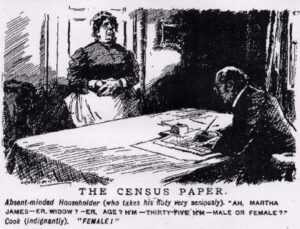 Census night in 1891 was on Sunday 5 April, and below is an extract from page 5 of a local newspaper, Jackson’s Oxford Journal, Saturday April 4 1891, describing how the census would be conducted throughout the country:
“THE CENSUS FOR 1891 The enumerators who have been appointed to assist in the work of taking the census throughout the country have been supplied with the schedules which are to be left at each house with the object of being filled up by the head of each family. The schedules have been delivered in the course of this week, and are returnable to the enumerators (who will call for them) on Monday next, April 6. In the papers furnished, the attention of the occupiers is called to the requirement to record all those present in the house on the night of April 4th including all visitors, and to the provision in the Act of Parliament, whereby a fine of 5/- can be inflicted upon any person who either refuses to give the required information, or wilfully gives false information in filling up the returns.
It will be the duty of the enumerator to open and examine to see that it has been correctly and intelligibly filled in, and he may ask any question which may be necessary to satisfy himself on this point. Errors are to be rectified by him upon the spot, and if, from ignorance, or any other cause the schedule has not been filled up, the enumerator must enter upon it himself all the particulars he can ascertain from the occupier or other competent member of the family. Should the schedule be lost, or mislaid, he will supply a fresh one. The strictest precautions will be taken to preserve as secret and confidential the information given in the schedules.”
This extract from page 8 of Jackson’s Oxford Journal, Saturday April 11 1891…
“THE CENSUS In accordance with the instructions of the Census Act, the Registrars of births and deaths for the eleven united parishes of this city and the Headington Union, Mr E. Butler and Mr J. Draper, appointed their enumerators, who during last week delivered the schedules at every house in the districts allocated to them, and they were filled up descriptive of all the persons who on midnight on Sunday the 5th, were dwelling therein, or were out at work or travelling, and were to return on Monday morning. The issue of every schedule had to be entered in a book in order to check its due return.
The schedules were called for on Monday, in nearly all cases, by the twenty-five enumerators Mr Butler employed. …. Whilst difficulties were rare… “It so happened, however, that there were several Italian street musicians in Oxford who could not be persuaded into giving their names, or any information, in fact, about themselves, and upon a compatriot living in Oxford proceeding to go to their lodgings in order to explain what was required of them, it was found that the whole lot had disappeared, consequently they succeeded in evading the Act.”
The enumerator for Beckley was Alfred Gunston, who lived in Stanton St. John, he was tasked by the Registrar, one John Draper, with collecting, a few days later, from each house the completed schedule, or census form, which had been filled in by the householder. (It is a common myth that a census enumerator knocked on doors and asked who was present; and then wrote down the details, often mis-hearing, or mis-spelling. There may have been isolated examples of that having been done, but this was very rare!) In many cases, the original schedule was filled in by a child rather than by the head of the household, because during the 1800s children went to school, or Sunday school, where they learned to read and write, whereas parents (of the older generation) were often not able to read and write. During the week following census night, the enumerator visited all of the houses, and collected the forms (the Schedules), collated them, and then wrote them up into his enumerator’s book, in schedule number order. The enumerator may have found it difficult to interpret the handwriting on the schedule, and he may have mis-transcribed some details. Except for the 1911 census, the original Schedules (forms) have, sadly, very rarely survived.
The census shows that the majority of the population had been born in Beckley, of the others the persons most distant came from the Isle of Wight, and from Cheshire. There were 33 properties with four or fewer rooms, and of these one cottage of four rooms housed two families (15 people in all) a second four roomed cottage housed two families (seven people in all), one three roomed cottage housed a family of eight, whilst a two roomed cottage housed two families (six people in all). Two properties were uninhabited.
